


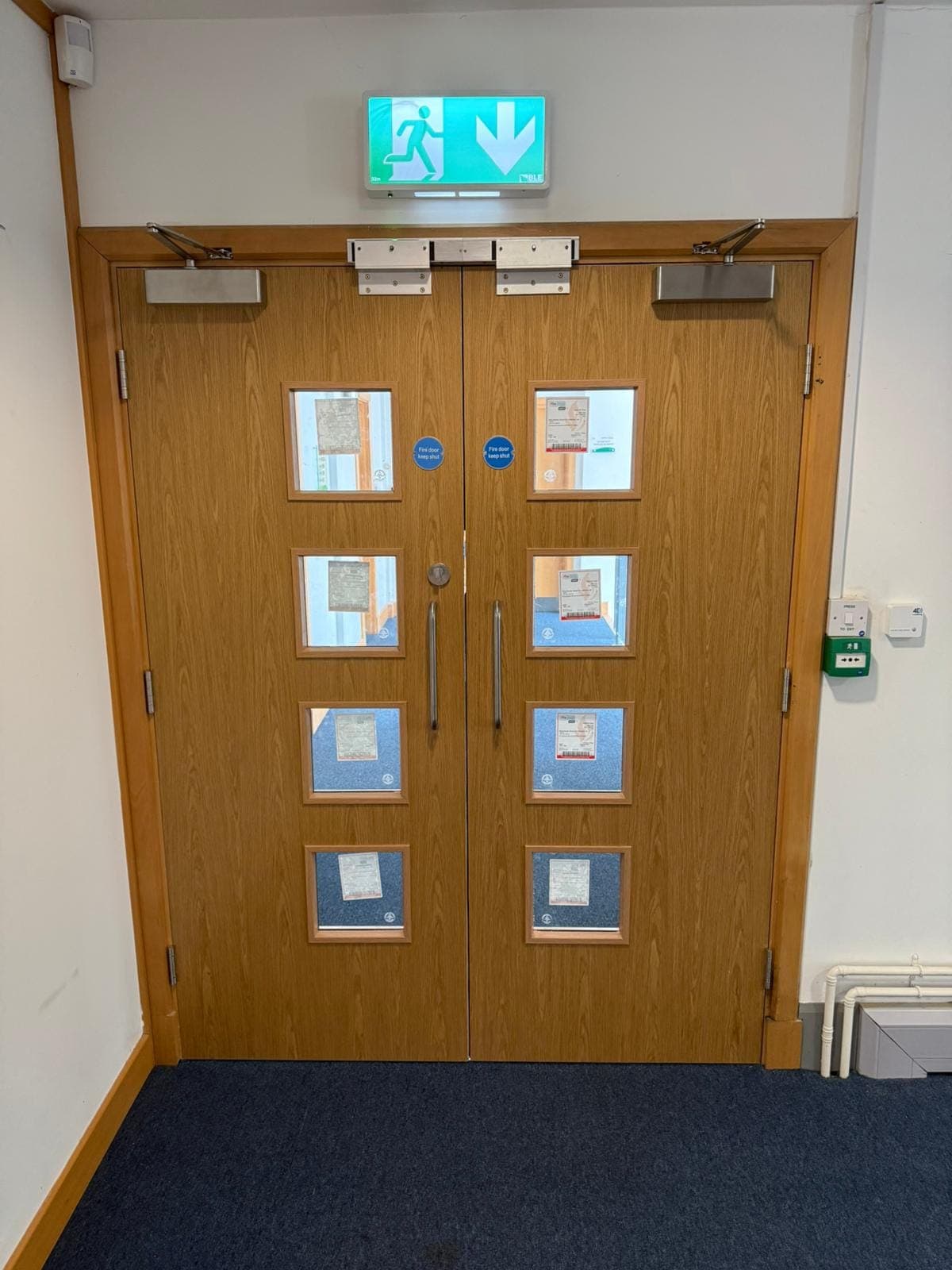
Woodgrain double fire doors
Dark woodgrain double fire doors with overhead closers on both leaves and Fire Door Keep Shut signage.

A&P is our fire door team. Fire door installation, inspections, maintenance and repairs for landlords, managing agents and commercial buildings.
A&P Fire Door Specialists and Joiners is the fire door team within Ash & Sons. They install, inspect, maintain and repair fire doors in residential and commercial buildings.
A fire door only works if every part of it does: the leaf, the frame, the seals, the hinges and the closer. A&P’s work is about getting each of those right when a door goes in, and keeping them right afterwards.
As the name says, A&P are joiners as well as fire door specialists. The same team can deal with the frames, linings and surrounding timber that a fire door depends on, and take on general joinery too.

Fire door installation, inspection and repair, and the joinery that goes around them. Enquiries come through Ash & Sons, so contact Lee or Chris to arrange an inspection, repairs or new doors.
Because A&P is part of Ash & Sons, one quote can cover fire doors alongside joinery or maintenance work.
Fire doors installed by A&P to the door’s certification and the manufacturer’s instructions, with the right frame, seals, hinges, closer and fire-stopping.
Fire door inspections by A&P for landlords, managing agents and businesses. Every door checked, with a clear record of faults and the work needed.
Fire door repairs by A&P: closers, hinges, seals, gaps and damaged leaves or frames put right with compatible parts, so the door works as intended.
Fire doors by A&P Fire Door Specialists and Joiners.
Dark woodgrain double fire doors with overhead closers on both leaves and Fire Door Keep Shut signage.
A fire door is part of a building’s fire protection. Closed, it holds back fire and smoke long enough for people to get out and for the fire to be contained. That only works if the door is in good condition and closes properly, which is why the law expects fire doors to be maintained and checked.
A fire door is tested as a complete assembly to resist fire for a set time, usually 30 minutes (FD30) or 60 minutes (FD60). Intumescent strips around the edge swell when heated and seal the gap between the door and frame. Smoke seals limit the spread of cold smoke, which is often the greater danger in the early stages of a fire.
Every part matters. A self-closer that doesn’t shut the door fully, a gap that has grown too wide, a damaged seal or a missing hinge screw can each stop the door doing its job.
In England and Wales, the Regulatory Reform (Fire Safety) Order 2005 makes the “responsible person” accountable for fire safety in non-domestic premises and in the common parts of buildings with more than one home. The responsible person is usually the employer, the owner or whoever controls the premises, such as a landlord or managing agent.
The responsible person must carry out a fire risk assessment and keep fire safety measures, including fire doors, in efficient working order and good repair. The Fire Safety Act 2021 confirmed that, in buildings with two or more homes, this includes the entrance doors to individual flats.
In England, the Fire Safety (England) Regulations 2022 add specific duties. In residential buildings with two or more homes, residents must be given information about fire doors. In buildings with a storey at least 11 metres above ground, the responsible person must also check fire doors at set intervals.
Whatever the building, regular checks are the simplest way to keep fire doors working. A typical inspection covers:
Not legal advice. This is a general summary to help you understand your duties. It is not legal advice and does not cover every building or situation. Your fire risk assessment, and professional advice where you need it, should guide what you do for your building.




Fire doors often come with other joinery: new internal doors, frames and linings, skirting and architrave. CCH Joinery, our joinery partner, can do that work in the same visit.
Free, no-obligation quotation. Commercial and residential work undertaken.


